Water Hammer Training
- Category: Awareness
- Duration: 2 to 3 days
- Level: Beginner to intermediate
- Price: from 900 € excl. VAT / day
- Course outline: Coup_de_Belier.pdf
- Interested in this course? Contact
- Course catalogue: Academy.pdf
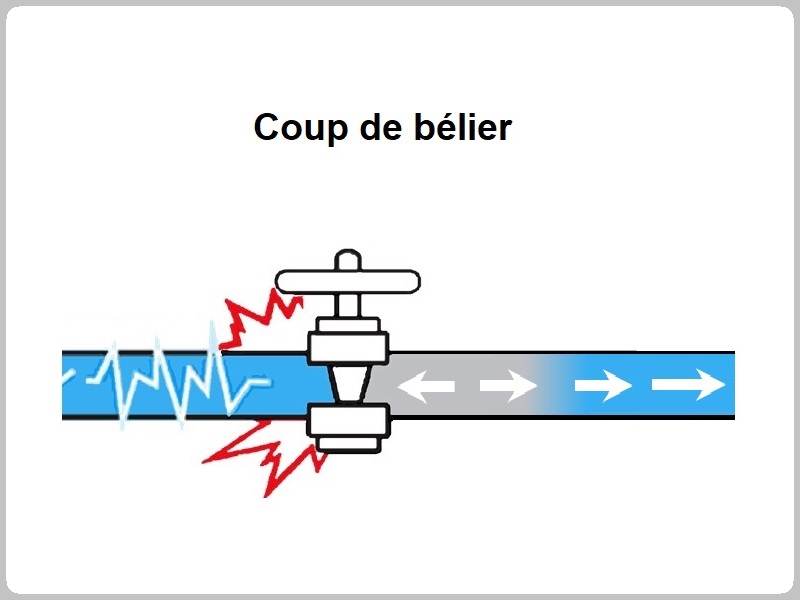
Numersalis offers a technical course dedicated to water hammer in hydraulic networks. You will learn to understand the physics of the phenomenon, identify its causes, analyse its consequences and implement the solutions that prevent dangerous overpressures and underpressures in your installations.
Water Hammer Training
Detailed programme
-
Learning objectives
- Understand the physics of transient flows and water hammer.
- Identify the causes of the phenomenon in an installation: valve closure, pump trip, start-up, rupture.
- Analyse the consequences: overpressure, underpressure, cavitation, equipment fatigue.
- Select, size and implement appropriate protection devices.
-
Syllabus
Day 1 — Understanding the phenomenon
- Introduction to transient flows in hydraulics: wave celerity, inertia and compressibility.
- Water hammer theory: origins and mechanisms, Joukowski formula, critical closure time.
- Calculation methods: basic equations and Bergeron diagrams.
- Case studies: water hammer incidents in drinking water, industry and energy.
Day 2 — Preventing and protecting
- Protection devices: relief valves, air vessels and surge tanks, surge shafts and standpipes, flywheels, air valves.
- Selection criteria and sizing of protections.
- Tutorials: calculations applied to typical networks.
- Numerical simulation: introduction to water hammer modelling (for example with Simcenter FloMaster).
- Summary and assessment.
Day 3 (optional) — Applied to your networks
- Analysis of a case brought by the participants: assumptions, calculation, choice of a protection.
- Writing a calculation note and an action plan.
-
Audience and prerequisites
Design-office engineers and technicians, water and process network operators, maintenance managers and project managers in energy, industry or civil engineering. Prerequisites: basic fluid mechanics (flow rate, pressure, pressure losses).
-
Teaching methods and assessment
Course materials, corrected exercises, calculation tutorials, simulation demonstrations, end-of-course assessment reviewed by Numersalis, certificate of completion.
-
Why train with Numersalis?
Our engineers handle hydraulic transients in their fluid and process simulation studies, particularly for the energy sector: the course is built on real cases and on the calculation tools we use on projects.
Details
F.A.Q
Frequently asked questions
-
Do we need simulation software to attend?
No. The day 1 and day 2 calculations are done by hand and in a spreadsheet; numerical simulation is shown as a demonstration. If your company has FloMaster or an equivalent tool, we include it in the tutorials.
-
Is the course aimed at drinking-water networks or industry?
Both: the mechanisms are identical. Case studies are chosen according to your sector (water supply, cooling circuits, process networks, power plants).
-
Can it be combined with the FloMaster course?
Yes, it is a common combination: two days on the phenomenon and protections, then two to three days getting started with FloMaster to model your own networks.
Other courses













interested in a course?
Contact
Address :
12 Rue Jean Pacilly
91120 Palaiseau
Email :
info@numersalis.com
Phone :
+33 9 77 37 82 45
they trusted us
Our clients